Showing posts with label Folding Paper. Show all posts

3.8.17

Paper Post


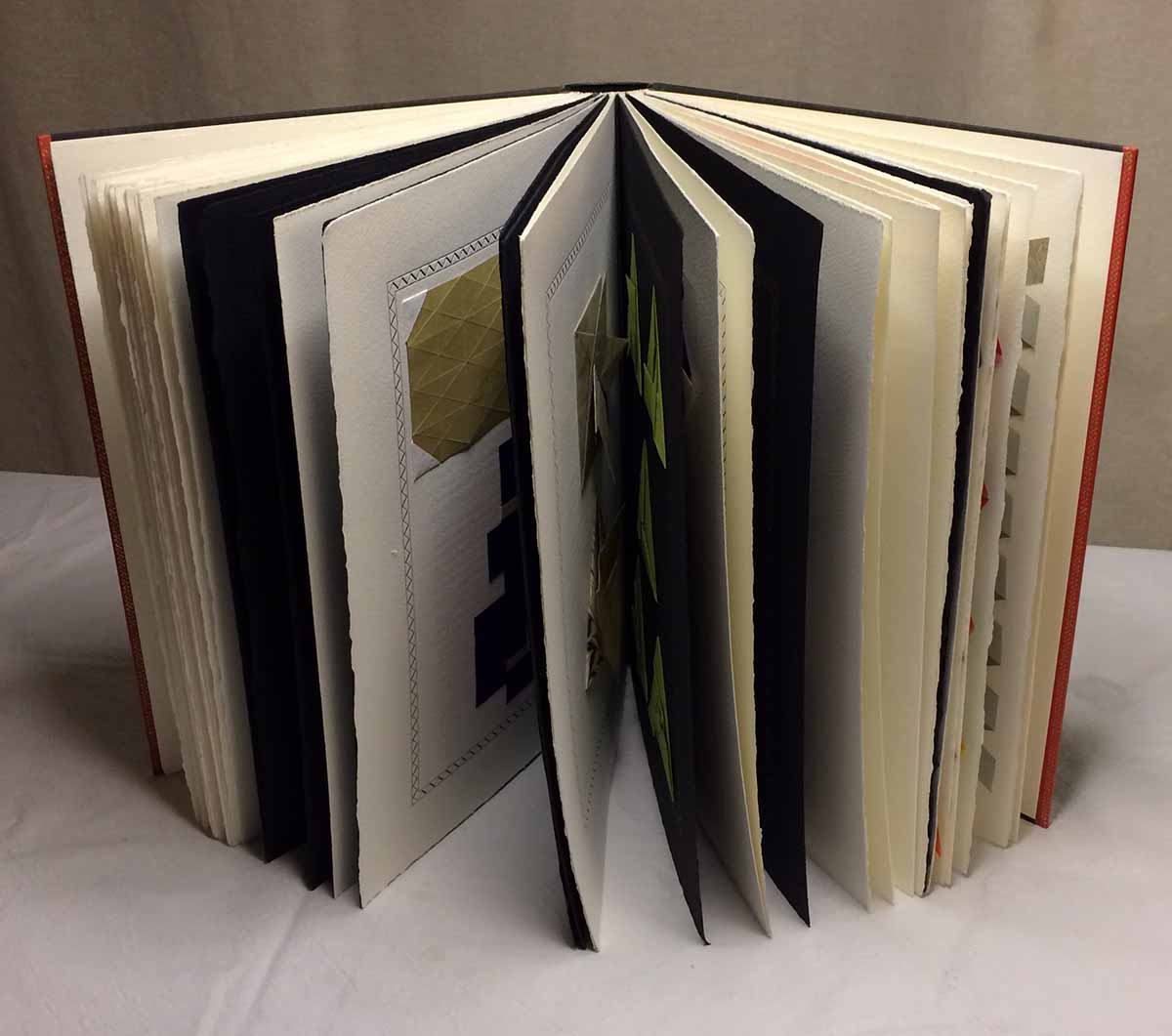
Got my first chance to actually spend time with a complete copy of Folding Paper this past week. It's hot in July, half of B.C. is on fire, and the smoke has started to blow west, giving Vancouver a martian-orange haze (surely the end of times...), so let's be lazy & just look at some shots of the book...


The book was printed by David Clifford at Black Stone Press. The title page, however, was printed at HM (on the handpress) because the sheet, which gets folded down to book size, was too large for David's Vandercook.


The book's text is interspersed and illustrated with dozens of tipped or inserted samples of the structures and techniques discussed...


The colophon employs the same folding technique used for the book's prospectus (hint: open & close by holding from the top right edge, and the sheet will open and close as required).

7.7.17

Folding Paper Unfolded


The tale of Folding Paper is now almost told: the second batch of copies (out of three) will be going out over the next few weeks. The first copies that went out, in May, enjoyed instant and enthusiastic reactions:

“FOLDING PAPER just arrived here and it is gorgeous, marvellous and WONDERFUL!!! If I weren’t already prepared by opening several of your other previous miracles I wouldn’t have believed it!”

Michael R. Thompson
Michael R. Thompson Rare Books

“Another absolutely wonderful production.”
Bill & Vicky Stewart
Vamp & Tramp Booksellers

It is a stunning achievement. You and Claudia and all who worked on it should be so proud. I see the volume with all its parts as a work of art fused with scholarship. Thank you for creating such beauty.
Anne Bromer
Bromer Booksellers


Presented in a box with a lift-off top (similar in structure to The WunderCabinet), the 80-page book rests on top of compartments holding 15 folded-paper structures described in the book, along with a magical Chinese thread box. Barbara Hodgson researched, wrote and designed the book (in collaboration with Claudia Cohen) over a two-year period. Before, during and after this process, Barbara and Claudia folded their way through 450+ paper samples needed for the edition.


After the book was printed at Black Stone Press in late 2016, Claudia tackled the challenge of making boxes and binding the books. Like their previous books on related topics - Cutting Paper, Decorated Paper, and the color series - it’s this tremendous amount of hand-work required to complete each copy that limits the number of copies in each edition. The letterpress is the easiest (or at least, most straight forward) part!

The through-line for all of Barbara & Claudia’s collaborations has been expanding the book form to explore and display a vein of the graphic & decorative arts, often one that has become outmoded or commercially unfeasible in contemporary applications. The book provides the history and context, while the embellishments - from tip-ins to peripherals - provide the opportunity to actually hold what is being described, to see how it’s constructed and how it works.


As with some previous projects, we took the new publication as an opportunity to ask Barbara some questions about the creative process behind it…

Which of the pieces/samples in the book proved to be the most technically difficult?

There were several kinds of technical difficulties that we had to overcome. Number one was our own abilities to fold paper with accuracy and precision. We practiced a lot before we reached the point of being confident that we had achieved sufficient proficiency. Practice also included trials on various types of paper, since a model might be successfully folded on one type of paper only to fail miserably on another. 


The second difficulty was figuring out how to place now-bulky pieces of paper within a book that must lie flat. Solutions included eliminating the bulkier models;* folding the models from the thinnest papers possibly; building up the spine through the use of shims; using thick, rigid paper for the book’s pages; and distributing the models judiciously. (* Some of these “bulkier models” ended up in compartments that sit underneath the book, in the box.) 


From the point of view of individual pieces being technically difficult to fold, many were worth the effort. One was the tessellated hydrangea [shown here], designed by Shuzo Fujimoto. It incorporates a number of ingenious folding techniques, making an intricate, three-dimensional yet flat model. Another challenger was a family of folded puzzles known as flexagons. These chains of equilateral triangles are assembled in such a way as to shift faces when folded.” 


How important is paper in the art form? Are there some techniques that work only with specific papers? And given the increasing decline in paper varieties available, how if the art form being affected?

Paper is 90% of the success of the art form. If the paper is inappropriate, the result will always be failure, no matter how proficient the folder. We found that many Japanese papers will work well for making envelopes but will be too soft for making pleats. Glassine is terrific for tessellations (repeated regular polygons) because it is thin, strong and translucent, but it is not appropriate for most containers. Lowly kraft paper is perfect for practice, as it can be folded into almost anything, but it is not a good choice when the aesthetics are important. In general,   strong, thin papers (with long fibres) were the best choice. In the book, we include three pages of paper samples, showing the kinds of papers we experimented with. 

The decline in the availability of papers is more of a concern when it comes to visual appeal. Widely available common papers, such as cotton bond and the kraft paper mentioned above, fold well but are not as appealing as other, harder to come by papers.


Are there any contemporary fine artists doing work with folded paper that you find engaging?

There are a number of contemporary artists and non-artists making amazing objects from folded paper. One of the wonderful things about folded paper is its appeal to architects, engineers, mathematicians, and others outside of the arts. They are using folded paper and its techniques to solve problems, create structures, design packaging, and so on. 

How, or when, do you two decide when a sample is bound into a book vs being separate (in the box)?

Any sample that can’t be folded flat goes into the box instead of being bound in the book. Some examples include certain three-dimensional pleats and tessellations, such as a pleated piece known as a trouble-wit [above], which collapses, expands, and revolves, but never lies flat; and a tessellation known as a waterbomb [below], in which a piece of paper is folded into a field of three-dimensional cubes.


Where would a person interested in collecting (old) folded-paper art or pieces look for them? 

“One of the existing sources of older pieces of folded paper can be found as children’s kindergarten exercises, once known as Froebel gifts and occupations. These are generally found in albums, dating from the late-19th to early-20th century. Outside of these albums, certain vintage Japanese origami books incorporate actual folded origami models. Otherwise, we found very little, in spite of our best efforts. Because of this paucity of material, we made all of the pieces we include in Folding Paper.”

You two have done two previous book similar in scope & concept, Decorating Paper & Cutting Paper. When you finish one of these projects, which take anywhere from 12 to 24 months, do you find that, having delved as deeply as possible into the subject, you just naturally move on to something new? (I’m doing a poor job of asking, once completed, are you done with the topic & ready to move on? Or possibly worse, do you find yourself thinking of one more thing you could have included…?

None of our books let us go when we have finished.

FOLDING PAPER - TECHNIQUE, DESIGN, OBSESSION
is a quarto-sized book, 80 pages plus tip-ins, set in Monotype Fournier and printed letterpress on Arches Cover paper. Each copy contains some 150 tipped-in examples from pleating, education, computational geometry, toymaking, origami and packaging. Included will be examples shown in progress, as well as finished pieces, in a variety of papers. Brief essays discuss approaches to folding techniques, the process of creating illustrated pieces, and paper choices.

The book is bound in quarter leather and paste paper with onlays, leather fore edges and extensive gold tooling. The design and combination of materials is repeated on the box, with interior compartments arranged to snugly fit the samples included.

The edition is 30 numbered copies signed by the creators, plus six A.P. copies. The edition was fully subscribed before publication, but copies may still be available from  HM’s regular booksellers; please contact them (see list at right) directly for details.

Claudia & Barbara promise their next book (publishing 2019-ish) will be equally imaginative, but no details offered yet...

13.3.17

Printing Leafy Letters


Back at the press this month, printing a calligraphic ABC by Seattle artist Francesca Lohmann. (She did the calligraphy for 2015’s Bromer bibliography, XI LXIVmos.) The inspiration for the book was a manuscript copy she created a few years ago (pages shown above). Titled An Alphabetical Accumulation, it presented 26 rectos, each adding the next letter of the alphabet, call done in red ink on a very thin, blue-tinged J. Whatman handmade paper. When I first saw it, the potential to make it a printed book was obvious: I would print (in black) the previous page’s accumulation, and Francesca could add the new letter to each page (in red) by hand, thus presenting the complete alphabet done by hand in each copy. 


While we kept the basic size (approx. 4 by 6 inches, 28 printed rectos) and format, Francesca decided to redo all of the calligraphy for this edition. The  presentation for each page changes to best present the letters included, and allow space for the letter to be added by hand. The book is entirely calligraphic - there is no type used. The reproductions of her calligraphy are done with polymer plates, printed on three different papers - T.H. Saunders, J. Whatman, and Crown & Sceptre - all printed damp.


The pictures above and below are proof sheets. I like overprinting different pages on the same sheet, a different kind of accumulation.


Printing will be completed within the week, and then Francesca will begin adding the calligraphy. The edition is 36 copies, so it will take her a while. Once that work is completed, the sheets will go to Claudia Cohen for binding. She is still pondering options, but we expect it to be a vellum structure of some sort.

With all the work still to be done after printing is completed, we don’t expect to have copies ready for issue before the end of the year - just in time for Christmas!

Folding Paper Update

An incomplete copy was assembled in time for display at the Codex book fair, in February, thanks to our friends Vamp & Tramp. I wasn’t there but I heard it received an enthusiastic response, which is partially responsible for it now being fully subscribed. We expect to ship copies in early summer.

5.2.17

Folded Like a Piece of Paper


HM isn't at Codex this year, but an almost-complete test binding of the new book from Barbara Hodgson & Claudia Cohen is; drop by Vamp & Tramp's table at the fair to see Folding Paper: Technique, Design, Obsession.

Check out HM's facebook page for a short video.

The book is the latest in their ongoing exploration of art forms related to paper. Similar to Cutting Paper in format and approach, the new book explores the art of folded paper, and presents a collection of samples on the pages and laid into the accompanying box. Brief essays discuss folding techniques, the process of creating illustrated pieces, and paper choices. Interspersed will be over 150 tipped-in examples from pleating, education, computational geometry, toy making, origami and packaging (some examples will be presented shown in progress, as well as finished pieces, in a variety of papers).


The book's prospectus alone is a work of art & engineering, and an example of the obsessive attention to detail throughout the book. Inside a "self-folding" wrap (some of which are made with waste sheets from old HM projects)...


...is a folded, printed sheet bearing the book's title...


...which opens, following an intricate series of folds, to reveal the book's production details...


Perhaps the most remarkable aspect of the piece - which illustrates part of the craft & ingenuity required for the art form - is how easily the sheet & wrap want to resume their folded state. A few dozen copies have been prepared, for customers & friends of the studio (i.e. if you ask for one, we probably won't have any left).


Folding Paper (9.5 x 12.5 in., 80 pp.) was designed and set in Monotype Fournier by Barbara. It has been printed on 200 g Arches Wove by David Clifford at Black Stone Press. (For technical reasons, the title page - which will itself be a piece of folded art - was printed at HM on the handpress.) Copies will be uniformly bound by Claudia, with an accompanying two-piece box. The box that will also contain about 15 three-dimensional pieces (shown above) and a separate Zhen Xian Bao (a magical Chinese thread box). All of the pieces will be created specifically for the book. The edition will be 30 numbered copies, signed by both contributors, plus six A.P. copies.

As with all HM publications, copies are available only through our regular booksellers (listed at right). If you would like more details, or want to reserve a copy, please contact one of them. Publication is planned for summer 2017.

2.1.17

Start with ABCs, Finish with Some Moralls


We’re going to maintain the momentum (finally!) achieved in 2016 through the New Year, with three major publications for 2017.

First in the press, but probably the last of the three to be issued, will be Francesca Lohmann’s calligraphic ABC book, An Accumulated Alphabet. This was originally created in 2014 as three manuscript copies. Over 26 leaves (rectos only) Francesca renders the alphabet, nestled among leafy vines, each page adding the next letter to the sequence. For HM’s printed edition, the previous page will be printed (in black) from polymer plates, and the new letter will be added (in red) by Francesca. Thus, each copy will contain, over 26 leaves, a complete calligraphic alphabet. The title page and colophon will also feature her original embellishments.


The reason this book is first up & last out is all the work to be done by Francesca after the printing, then the binding by Claudia Cohen, who is still pondering the details but has been making vague comments about limp vellum structures. The book will be 28 printed leaves (approximately 5 x 7 inches), the paper being a combination of Crown & Sceptre, T. H. Saunders, and Whatman handmades. The edition will be 30 numbered copies and six A.P. Hopefully issued, through HM Editions, by the end of 2017.


The first book that will be issued in 2017, by HM Editions, is the latest collaboration between Barbara Hodgson and Claudia Cohen: Folding Paper: Technique, Design, Obsession. In a similar manner and format as Cutting Paper, the book explores the art of folded paper, and presents a collection of samples on the pages and laid into the accompanying box. Brief essays discuss approaches to folding techniques, the process of creating illustrated pieces, and paper choices. Interspersed will be over 150 tipped-in examples from pleating, education, computational geometry, toy making, origami and packaging (some examples will be presented shown in progress, as well as finished pieces, in a variety of papers).


Folding Paper (9.5 x 12.5 in., 80 pp.) was designed and set in Monotype Fournier by Barbara. It has been printed on 200 g Arches Wove by David Clifford at Black Stone Press. (For technical reasons, the title page - which will itself be a piece of folded art - was printed at HM on the handpress.) Copies will be uniformly bound by Claudia, with an accompanying two-piece box. The box that will also contain about 15 three-dimensional pieces and a separate Zhen Xian Bao (a magical Chinese thread box). All of the pieces will be created specifically for the book. The edition will be 30 numbered copies, signed by both contributors, plus six A.P. copies. Publication is planned for late spring/early summer. 


The long-promised book featuring original leaves from George Wither’s Collection of  Emblemes Ancient & Moderne (England, 1635) is finally going to hit the press. Details are still being finalized, but at this point we can report that the book will be approximately 8 x 12 inches, 50 pages (plus sample leaves), issued in two states from a total edition of 66 copies.

This is the start of the new publishing schedule, so this is it until he start of February, at which time I'll be posting more images & details about Folding Paper. Please note that if you have any interest in that book, contact one of the booksellers listed to the left for details and discuss reserving a copy.