Showing posts with label Jim Westergard. Show all posts
15.4.15
Some Things Fishy
Got a note from oddball Jim Westergard reporting a recent flood of online interest in The Intruder, which features his wood engravings published by Deep Wood Press in 2012. My question is, why is this the first time I'm hearing about it at all?
The book, by Robert Traver, falls in the angling category (which probably has a larger audience than books on books by a factor of ten). Jim's note made me realize that, despite having no interest in fishing, I have a number of books on the subject...
Alison's Fishing Birds, the first piece of printing by Jim Rimmer I got.
A 1997 reprint of Pool & Rapid, published by the (Roderick) Haig Brown Fly Fishing Association on Vancouver Island. I got this because it was designed Bev Leech and is one of the last letterpress books printed at Morriss Printing. But haven't actually, like, read it. But you can if you want to: the association still has copies & they're available at half the issue price!
And the jewel in the fishy crown, selections from the diary of Roderick Haig-Brow, published in five volumes by Beaverdam Press in 1992. I wrote about this before. Stunning piece of work.
There are lots of other stunning examples of fine press publishing that, despite being about fishing, I would add to the collection if the right copy came along. The first two publications from D. R. Wakefield's Chevington Press were about trout. His work is fantastic. One guy doing everything, intaglio and letterpress combined.
Alan James Robinson did at least two books about angling. I think it had a fly incorporated to the binding or box. Others have done that as well. Don't like it.
Coincidentally, one of the titles in the selected bibliography of publisher Kevin Begos Jr included at the back of About Agrippa is an angling title: In Praise of Trout - & Also Me. (As if the trout wasn't enough, we get the personal history larded on; thanx Oprah.) I suspect this was a commission book for Begos...
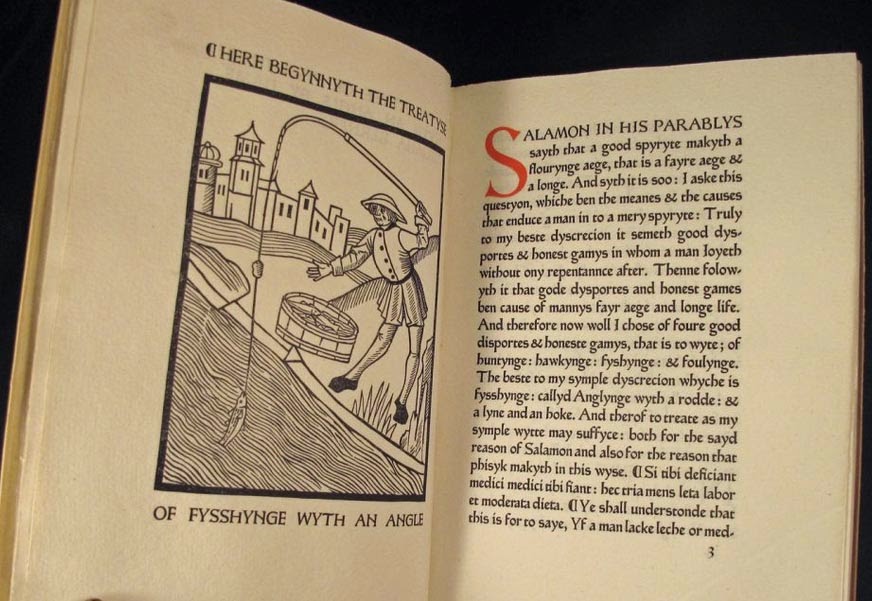
A bookseller once tried very hard to convince me to buy a copy of the Ashendene Treatyse of Fysshynge printed on vellum. It was priced to sell, but I kept saying, I just don't are about the topic, especially in olde englishe.
Anyway, despite the fishiness of it, I'm sure Jim's new book is very kool.
9.1.12
Westergard's Up To Something Fishy
Jim Westergard's site recently posted six new engravings he's editioned, the blocks having been commissioned for an upcoming book from Deep Woods Press. The one above, "John's Browns," is our particular favorite. The six engravings will be included in The Intruder, a chapter from Robert Traver's (a.k.a. John Voelker's) 1960 book Trout Madness. Publication is slated for later this year.
Each of the six engravings measures approximately 4 x 6 inches, and has been printed by Jim in an edition of 20 copies. His original prints remain among the best art deals available, especially for work from an artist of his caliber.
26.11.11
Oddball in Toronto
Oddball's author & artist Jim Westergard takes his show on the road this weekend, appearing at an event in Toronto tomorrow (Sunday 27 November). Jim will take part in panel discussions with author Jon Evans, whose book Beasts of New York Jim illustrated with original wood engravings; and with Toronto printmaker George Walker, about the art and craft of wood engraving. Details can be found here.
Beasts of New York was published by Porcupine's Quill, with the wood engravings reproduced offset. Fans of wood engraving, and Jim's wood engravings in particular, should note that copies of the original prints, pulled and signed by him (in editions of 25), are available. He also assembled ten complete sets of the prints, along with an original drawing, in a slipcase. A few of these are still available directly from Jim.
25.10.11
Making an Exhibition of Ourselves
Another post from last weekend's Wayzgoose printing fair, this one all about us (mostly). Jim Westergard and his wife flew in from Red Deer to accompany Oddballs' first (& only, at least by us) exhibition in Canada, and it was brilliant to have them on hand. As previously mentioned, we printed up 10 copies of a poster ganging all 40 (plus one) of the oddballs together, which Jim signed and numbered with assistance from the HM devil, before the doors opened. These are 22 x 30 inches (image area is about 12 x 21 inches), giclée printed on 180 g all-rag paper. A few copies of these remain, priced at $60.
Barbara Hodgson was on hand to discuss The WunderCabinet, a display of which occupied most of HM's second table. As shown above, she didn't get a minute's rest all day, in large part due to an interview with her about the project which aired on CBC Radio's North By Northwest show that morning. As proven in previous years, a mention of the wayzgoose on Sheryl McKay's show assures a significant boost in attendance at the show, and this year was no different: many people came in specifically to see the book and meet Barbara, having heard the interview that morning. A podcast of can be found here.
Jim was diligent about pulling his weight as an exhibitor, but he did manage to make a few circuits of the room over the course of the day. Below he's talking to HM's secret weapon, Reg Lissel, who was demonstrating how to make paste papers.
Jim brought along a number of the trade books that feature his artwork, and lucky people snapped these up (and got them signed). Jim's off to Toronto in late November for an event organized by Beasts of New York publisher The Porcupine's Quill. It will be an evening's discussion between/among Jim, author Jon Evans, and Toronto printmaker George Walker.
22.6.11
Printing Oddball Stories
There's been a lot of whining on this blog in recent months about the work of printing Oddballs. Visitors - which HM's Webmaster reports now total in the several - have asked about the process of printing a sheet. So, in an effort to avoid the work we've been moaning about, we took some photos to illustrate the sequence of events. Each sheet is printed over a period of three days: on the afternoon of the first, we wet the paper. On the second day, we print the inner form, and on the third we back it up.
We're using an abbreviated form of Gabriel Rummonds' recommended method for damping paper (which is to stack the sheets between dampened pressing boards). We need 37 good copies of the book (the edition is 30 plus six hors commerce and one binder's dummy), so we're printing 48 sheets. This takes between five and six hours, which is exactly how much time we have for work while HRH is at school.
We wet a sheet by running it through a vat of clean water, shaking off the excess and then laying it down on a dry sheet to start the stack.
Then two dry sheets are smoothed across the wet sheet. The Guarro laid paper we're using doesn't cockle and react as violently to the water as many well-sized handmades would, so smoothing the dry sheets across the wet one is not difficult.
Once the stack is completed, it is put into a heavy garbage bag, put under light weight, and left for a few hours. Before going to bed, we restack the paper, simply starting at the top of the stack and moving each sheet over in turn to make a new stack. This reverses which sheet faces which, and helps disperse the surface water from the wet sheets. The stack is then wrapped again and pressed over night.
Below is one of the four platen bearers on the bed of the press (this one manufactured & sold by Steve Heaver of the Hill Press). The bulk of Oddballs consists of the one-page biographies, which appear on versos. We're printing all of these first, so that the bearers could be adjusted to even the platen's fall on the one-sided form. This is done using Rummonds' "zero packing" system, adjusting pieces of the packing material between the back of the tympan and beneath the bearers. When it comes time to print the frontmatter (spreads), we'll return the bearers to a more level setting.
In the morning of the second day we roll out the ink and leave it standing while getting the press ready. We use a piece of half-inch glass as an ink slab (on a non-slip mat) and a 60-dur roller from Takach Press.
The text to be printed is set in place and a position proof is taken, plus a few impressions on tissue for makeready. The pages we're printing are pretty consistent in length and shape, the only difference being the number of lines, so makeready is straightforward. The hinged Mylar window that covers the makeready can be seen (with some text offsetting) on the left side.
In addition to makeready, we make some adjustments to the roller bearers with tape, to ease the transition on to and off of the text block. (The bearers are locked up above and below the type, as the roller must pass perpendicular to the lines when inking.) As many as six pieces of tape may be required, arranged in a narrow band across the vertical area occupied by the first and last letters in the lines.
A few proofs are then pulled on newsprint to check impression and the roller's ink coverage. Then we tuck into the stack of dampened paper. After removing the stack from the plastic bag, it is covered in a thick layer of dampened cotton cloth. The stack is uncovered and a sheet removed only when the type has been inked and is ready for printing.
When properly dampened for printing, a sheet of paper should feel cool to the touch but not wet on its surface, and it should be completely relaxed (i.e. floppy).
Before being printed, the sheet must have holes pricked in exactly the correct position, to fit on the press' points. We use a thick piece of foam core covered in plastic (so that it doesn't react to the papers' dampness) as a base. A piece of Mylar the same size as the printing sheet, with holes pierced in the proper spots, is then laid over the printing sheet, and a needle is used to make the holes. This all happens in less time than it takes to describe, so that the paper doesn't start drying out.
A mould-made sheet like the Guarro will expand almost entirely across the grain and very little (if at all) vertically, so it would theoretically be possible to prick the holes before damping the sheets, but we believe this creates too much potential for error. A handmade expands equally in all directions, between 2 and 4%. We once tried to gauge this expansion with test sheets, so that we could prick the holes before damping. But even the slightest error will ruin the whole point of printing on points, which is to achieve the most precise registration possible. So we make the holes in the dampened paper before printing the first form.
The sheet is then laid on the points. Between it and the Mylar window covering the makeready is a slip sheet, which is most important when backing up: if not used, the printed side will offset to the packing, and then transfer to subsequent sheets. But to ensure impression is consistent throughout, and to not "burnish" the verso against the Mylar when pulling an impression, the slipsheet must be used even for the inner form.
The frisket is lowered.....
the bed rolled in, an impression pulled, and voila....
The image above shows the impressions from the two roller bearers along the frisket (smeared here from various cleanings). Strips of tape are laid along the frisket in these areas, to prevent the ink from soaking through. Pieces of tape covering the area where the frisket contacts one of the platen bearers (top left) can also be seen; this tape is simply to help the paper withstand the repeated impressions (it will wear there first).
The slipsheet showing some cockling caused by the dampened printing sheet. It is replaced for each impression.
On Day One, the printed sheets are placed in a second stack, under a damp, heavy cotton cloth. If deemed prudent, each is lightly misted as it is laid on the stack, to maintain the ideal dampness.
On Day Two, after the last run (outer form), each printed sheet is interleaved with a pressing board, to wick out the moisture. When printing is completed, this stack is pressed tightly overnight. It is then restacked with fresh pressing boards the next day and pressed again, ultimately yielding dry, flat sheets. (When printing on handmade paper, we remove the sheets from the boards before they are completely dry, and press them very hard overnight, then restack them to complete drying. This pressing while still slightly damp gives the paper a wonderful crispness, but the process doesn't seem to yield the same results with mouldmades.) For Oddballs, the printed sheets are tucked away under the bench, the entire stack left under medium weights. The book will consist of 24 printed sheets; in the image below you can see we have completed 15 of the 24.
When all the printing is completed, copies will be collated, and the engravings will be tipped to the rectos facing their biography. Here's Unn, awaiting her text...
3.6.11
It's Good for Breakfast Too
While HM toils away printing the text for Jim Westergard's exhaustive study of interesting characters from recent & long past, the artist has moved on to new projects, such as studying aspects of Irish culture in the glass shown here. Another is his ongoing series See What I'm Saying, exploring how "words and phrases can sometimes suggest images that are either variations of their meanings, or totally different." He's just posted a new addition to the gallery: "God willing and the creek don't rise." As with his studies of oddballs, Jim supplies a brief history lesson with humor & irreverence.
About Oddballs, we have reached the 50% completion point, which means 12 of the 24 folio sheets have been printed. The project is going to be a few months later than originally promised, because HM decided to start over after printing the first six sheets: a number of factors that combined to leave us feeling dissatisfied with things. The right decision. Progress on Oddballs v.2 has been much better.
6.4.11
Help Me Somebody
Before printing of Oddballs could start in earnest, we had to tear the paper down. Which is one reason we kept delaying things; it is such a boring job. We're printing on some of our coveted vintage Guarro mouldmade laid paper (the same stock used for HM=X). Each book requires 14 signatures of two sheets (i.e. eight pages) each; each sheet is almost a half full sheet of the Guarro. Almost but not quite; we need to remove two inches from the width. We used a cutter to halve the sheets (so the heads will be a trimmed edge), leaving the deckle on the bottom and one edge. We didn't like the look or feel of the other fore edge being trimmed, so those have to be torn. We'll print 45 copies to get 35 we like. That means 630 full sheets; once halved, that's 1,260 printing sheets. So that's 1,260 fore edges that need torn. And being a laid paper, we have to ensure we keep track of the rough & smooth sides. You can see why we procrastinated.
The photo above shows the stack to be torn, the offcuts, and the trimmed sheets. The offcuts will be further trimmed - mercifully using the cutter again - to a width of one inch, for use as shims in the binding. Since the engravings are being tipped into the book, the binding - the spine - must account for the additional thickness they add to the text block, and this is done by adding shims to the folds of the signatures. With the trial binding, Natasha Herman has determined that a one-inch strip of Guarro folded twice (to make four thicknesses) inserted between the outer and inner sheet, will be sufficient. (No, we're not printing on this horrible yellow Guarro, but it's the same weight as the white so we used it for the blank dummy.) This is a detail one should always look for when presented with a book that includes tipped-in items.
Progress was somewhat expedited by setting up a jig: a ruler fastened at one end to the cutting mat, and a mark exactly 17 inches to the left. By aligning each sheet to the mark and horizontal, the edge can simply be torn along the ruler's edge. Nonetheless, it is tedious work. So tedious that, after years of rejecting all inquiries along this line, we have begun entertaining the idea of a HM apprentice. This is exactly the kind of work intended for the young & keen. There's even room in the studio for a bedroll.
As the idea took hold, we thought of other tasks suitably interesting and valuable to the studio's ongoing success. Like harvesting the moss from our roof (the apprentice could sell it at the nearby weekend farmers' market). And so, investigations into the feasibility of what we're tentatively calling the Kramerica Memorial Apprenticeship are underway; stay tuned for application details.
2.4.11
Prospective Oddballs
Copies of the prospectus for Jim Westergard's Oddball series have gone out. Jim sent us 27 copies of the Hunter S. Thompson portrait, which is featured as the sample spread in the notice, so 27 copies were printed, sewn into wraps, and numbered. Initial response to Jim's work has been - no surprise - enthusiastic. One correspondent in the U.K., however, thought the content wasn't right for a clientele with a too "Eurocentric" focus. We agree, and this is, of course, why we were attracted to the series in the first place - Jim's ability to inject humor and perversity into a medium that too often takes itself terribly seriously. As Barry Moser says in the introduction:
“Wood engraving is a dark medium...I don’t know how Westergard does it, but he has an uncanny ability to pull humor out of that dastardly valley of shadows. Despite the dark odds against him, he manages, again and again, to wrangle some of the funniest wood engravings I have ever seen.”
While printing of the various oddball biographies is underway, we continue to play with ideas for the title page. Below is a quick digital sketch of an idea we had, incorporating "thumbnails" of all 40 oddballs in the setting, but the size reduction is too great and they'd end up looking like thumbprints. Nonetheless, the concept we still like, and we're talking with Jim about other illustrative options...
13.3.11
Blowing Smoke
At the risk of jinxing the project's possible, eventual completion, we report here starting work on Oddballs. Although we generally find excuses to not issue prospectuses, we decided it might be appropriate in this instance. Turns out that this can be an excellent way to warm up for the main event - who knew? Here's a shot of the makeready for the outer forme (the press dislikes such unbalanced spreads, and required much adjustment of the platen bearers to even things out).
However, we are following past practise in issuing fewer copies of the prospectus (27) than there will be of the book itself (30). Each copy is sewn into a printed wrap, and the inside spread shows one of the Oddball biographies and prints from the book. We chose Hunter Thompson, for no particular reason. An interesting aside about this print came to us via new friend Miles Wigfield: turns out the print was featured on the cover of the Society of Wood Engravers quarterly journal Multiples, and elicited a rebuke from a member who objected to an image of someone smoking being given such prominence. Happily, the wet blanket was pelted with butts (some still glowing) in the Letters section of the following issue. As someone noted, given that it's Hunter S., Jim could have portrayed much more venal antics.
The prospectus: printed on the same Guarro laid paper we're using for the edition. The page is 8.5 x 12. 5 inches, the type is Dante. The engraving was printed by Jim on Zerkall, and tipped on to the page, as is the plan for the book (binder Natasha Herman is currently working on a dummy, figuring out all the shimming required to balance out 40 tipped-in prints & yield a pleasingly rounded back). Copies will be going out to HM's regulars in the coming week.
11.3.11
T. E. Lawrence & Siegfried Sassoon
Fellow handpress printer Miles Wigfield, in the U.K., recently published a T.E. Lawrence item featuring a wood engraving by Jim Westergard. Details of T. E. Lawrence and Siegfried Sassoon - A Friendship from the Reading Room Press's site:
"This was the text of the talk that Dennis Silk gave at the Imperial War Museum in 2007. The chance to put the names of two of my literary heroes together with his name on a title page was an opportunity that no self-respecting private press printer could allow to pass. The portrait illustration, engraved on boxwood by Jim Westergard, I suggested, might be the first published image of Sassoon and Lawrence together for even though Lawrence attended Sassoon's wedding no photograph of them both appears to exist. Bound by Chris Hicks, there were 120 copies. [A few remain: £30 + p&p.]"
Miles has two Albion presses and, based on the photos on his site, a pristine studio (note the cool drying rack hanging from the ceiling). The press is his avocation, and therefore proceeds at a pace that makes publishing pleasurable but never onerous. He is particularly interested in wood engravings, and like HM makes a habit of commissioning work by artists whose names may not (yet) be terribly well known among the book crowd.
"This was the text of the talk that Dennis Silk gave at the Imperial War Museum in 2007. The chance to put the names of two of my literary heroes together with his name on a title page was an opportunity that no self-respecting private press printer could allow to pass. The portrait illustration, engraved on boxwood by Jim Westergard, I suggested, might be the first published image of Sassoon and Lawrence together for even though Lawrence attended Sassoon's wedding no photograph of them both appears to exist. Bound by Chris Hicks, there were 120 copies. [A few remain: £30 + p&p.]"
Miles has two Albion presses and, based on the photos on his site, a pristine studio (note the cool drying rack hanging from the ceiling). The press is his avocation, and therefore proceeds at a pace that makes publishing pleasurable but never onerous. He is particularly interested in wood engravings, and like HM makes a habit of commissioning work by artists whose names may not (yet) be terribly well known among the book crowd.
9.3.11
That Dastardly Valley of Shadows
Jim Westergard's blog includes a detailed description of his process for creating a wood engraving, including photos of the different stages. An interesting behind-the-scenes look from the creator of our upcoming Oddballs book.
“Wood engraving is a dark medium...I don’t know how Westergard does it, but he has an uncanny ability to pull humor out of that dastardly valley of shadows. Despite the dark odds against him, he manages, again and again, to wrangle some of the funniest wood engravings I have ever seen.”
from Barry Moser's Introduction to Oddballs
25.1.11
Beasts Contained
The two text pages for inclusion with Jim Westergard's suite of prints Beasts of New York were printed at the end of last week. They've been dried, pressed & trimmed to final size, so this week we go off to the local bindery to have ten slipcases made up. For the chemise we had just enough of some large, heavy taupe sheets with red highlights, made by Reg Lissel, lying around. The one thing we forgot to print (because we're not very bright) was the spine label for the slipcase, so that'll have to get done this week.
The image below shows the colophon sheet (still to be signed & numbered by Jim) and the drawing, titled "the King Beneath," that will accompany this suite. The sheets measure 6.5 x 8 inches. Jim printed the engravings on Zerkall, and did the drawings on a heavier and toothier Hahnemuhle. The text was set in 18-pt Perpetua (with 36-pt used for the title) and printed on Arches Wove paper.
All 11 prints in each suite are uniform in edition number; the suites account for numbers 16 through 25. Only eight of the ten suites are being offered for sale, priced at $750. Contact Jim directly (jimwest at telusplanet.net) if interested.
The image below shows the colophon sheet (still to be signed & numbered by Jim) and the drawing, titled "the King Beneath," that will accompany this suite. The sheets measure 6.5 x 8 inches. Jim printed the engravings on Zerkall, and did the drawings on a heavier and toothier Hahnemuhle. The text was set in 18-pt Perpetua (with 36-pt used for the title) and printed on Arches Wove paper.
All 11 prints in each suite are uniform in edition number; the suites account for numbers 16 through 25. Only eight of the ten suites are being offered for sale, priced at $750. Contact Jim directly (jimwest at telusplanet.net) if interested.
19.1.11
Beastly Distractions
Subscribe to:
Posts (Atom)