

The past month has been so busy I forgot I had a July 1 deadline for this blog. I'm sure what follows will read like something bashed out in a hurry...

Beyond that, I’m hoping to a series of books, each one a collaboration with an artist featuring new, small prints around some theme or topic or their choice. The format is entirely inspired by (copied after) Barry Moser’s Cirsia. Intaglio prints will be featured but it’s not a requirement. There will be no text beyond a title page, a very brief introduction, and colophon. Each print will be presented on a recto. The editions will be small – probably no more than 30 copies – because the artist will be doing all their own printing, and uniformly bound at HM (that is to say, each edition will be uniformly bound, but series will not be uniform in size or binding). %20First%20Edition.%20The%20Kelmscott%20Bookshop%20ABAA.png)
Most of the recent activity was related to issuing and shipping Sci-Fi Violence. Thanks to everyone who sent comments and thoughts about the poem and the book; apologies to all who didn’t get a chance to order a copy. For those who responded to reserve a copy of the chapbook reprinting, it’s in the press right this minute, but Briony needs a month or so to finish the frontis. Copies will be ready by the end of the summer.
The next HM publication is in the pre-press stage. The artist has signed on and we’re finalizing things, foremost the paper(s) we’ll use. I won’t share details of the who and what until it’s closer to publication, but I will share that the book feels like a complementary follow-up to Sci-Fi Violence in tone and ambiguity (although it is prose). It’s a story I’ve wanted to print for some years but only last year did the artist whose work suited appear.

Beyond that, I’m hoping to a series of books, each one a collaboration with an artist featuring new, small prints around some theme or topic or their choice. The format is entirely inspired by (copied after) Barry Moser’s Cirsia. Intaglio prints will be featured but it’s not a requirement. There will be no text beyond a title page, a very brief introduction, and colophon. Each print will be presented on a recto. The editions will be small – probably no more than 30 copies – because the artist will be doing all their own printing, and uniformly bound at HM (that is to say, each edition will be uniformly bound, but series will not be uniform in size or binding).
%20First%20Edition.%20The%20Kelmscott%20Bookshop%20ABAA.png)
On that point, a quick aside: I had an interesting conversation with an artist today (not the one who’ll be collaborating on the new book) about how operations like HM approach the incorporation of art (i.e. prints*) to a project. If the word illustration is used in a book’s description, I think it says a lot about how much freedom the artist is given to respond to, or expand on the text. I’ve never seen the point of inviting an artist to contribute, and then telling them what to do. I've also never been interested in publishing books with images that simply & literally illustrate what's happening in the text. There are logistical issues and physical parameters that need to be set down – e.g. page size, the number of prints, how & where they’ll be inserted to the text block all ideally decided in consultation with the artist. However, in terms of what their contribution – the art – ends up being, the publisher’s role is to pick the artist and then stay out of their way. I didn’t see any of the prints, or even sketches, for Sci-Fi Violence until they all arrived, ready for binding. We discussed how many prints, the paper, and whether the double-page prints should fold out or be presented as two halves, but ultimately these decisions were hers. I can imagine instances when illustration is what the publisher wants, but in that case you don’t need an artist. This is basically the story of Barry Moser’s dis-satisfaction with his experience working with Andrew Hoyem on the Arion Moby-Dick. I’ve always wondered if Hoyem didn’t fully explain to Moser from the start what he wanted (historically accurate technical illustrations), or if Moser didn’t fully hear or believe what Hoyem said.
* Unless the original image matrix is digital (like Scott’s were for Epilogue), photo-offsets and digitals aren’t prints, they’re reproductions. Combining letterpress with photo-offset reproductions seems contradictory. Unless it’s what the artist wants to do, in which case it might be interesting. But if the artist wants to do it because they don’t know how to make actual prints, it’s just reproductions.

I’ve also been pulling together items for the promised summer book sale on the HM site. It’s gotten bigger than originally planned, for a few reasons. In addition to a group of books pulled off my own shelves, and a small group of HM titles (last copies mostly), there will be a number of HM titles from the library of long-time HM friend David Clifford, plus an interesting group of Aliquando Press books that fell out of Will Rueter’s move to a new studio. I’ll be sending a notice out to the mail list when the sale pages go live (before the end of July).
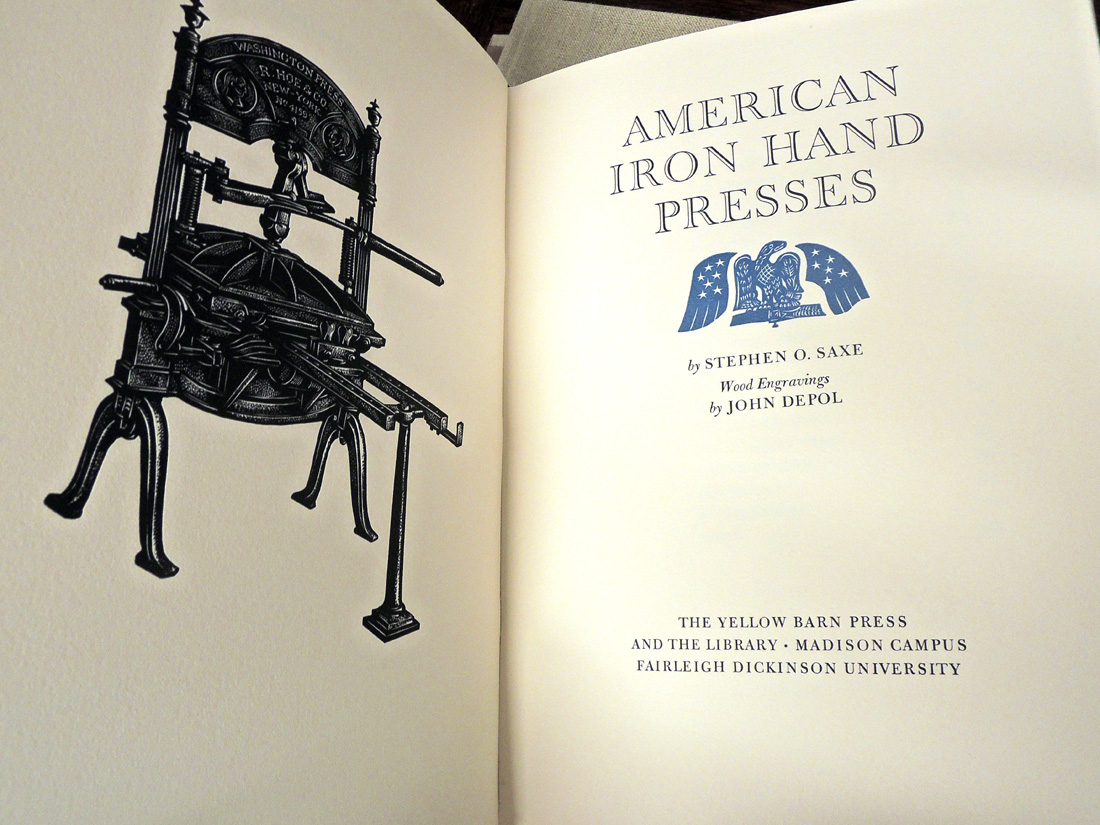
Finally, another conversation I had since the last post, about the phrase handpress, as in printed with a handpress: a handpress is a type of press wherein what’s being printed is inked by hand, rolled under a platen (by hand), and printed (by hand). A press operated by hand is not necessarily a handpress: a Kelsey or Adana tabletop, or even a C&P treadle, is not a handpress (even though the printer is risking their hand every time they feed a sheet into the clamshell). I guess a Vandercook with its inking unit removed (so the type is inked by hand) would be a handpress, but I don’t think may people use Vandercooks that way. When all this started, I was offered a beautiful Korrex Nürnberg Hand press gratis but for reasons that remain vague, I wanted to print on a handpress. So I gave the Korrex away and spent loadsadough to buy my big ugly & beautiful green & yellow O-S. Life could have been so much easier with the Korrex, but probably less fun. Having said that, if anyone’s looking for a big green & yellow press, get in touch...
Much of this post must sound dogmatic, for which I do and do not apologize. In pursuits like this, one needs clear definitions and opinions. I promise not to miss the October 1 deadline.


