Showing posts with label About Agrippa.... Show all posts

1.6.23

Adagio's C-S , The Master Craftsman


I had a couple of days between projects last month so I attended to a few binding projects. I’d recently acquired a copy of Leonard Bahr’s C-S, The Master Craftsman (Adagio Press 1969) in sheets. I’d seen the book over the years but never felt the beed to own a copy. The copy in sheets was cheap, plus it included several proof and trial-setting sheets, including a completely different title page, which are always of interest to a printer. 


The two Doves leaves required were lacking, but there are enough Doves leaves kicking around HM from the Pollard project Ideal Book projects to easily fix that shortcoming. 


One of the two sheets included in the edition was from the Bible. I still have some of those and chose a bifolium (half a printed sheet; the Bible was printed four up) that showed some of the foxing for which Vol. 1 is infamous.  For the second I acquired a leaf from Paradise Regain
d from the excellent Kelmscott Bookshop.
 

It’s not an uncommon book, copies can be found. It seems to have been bankrolled by the bibliophile Norman Strouse, who provided the leaves and a brief essay about Cobden-Sanderson’s career. There’s nothing new in his essay but it’s engaging enough, and includes a paragraph on
the purpose and value of leaf books, for the boneheads who need it explained. John Dreyfus contributed a more penetrating essay, about the partnership between C-S and Emery Walker, with some speculation  – based on previously unpublished legal documents – on why it disintegrated and C-S later dumped all the Doves type and matrices in the Thames. It paints a sympathetic but not apologetic portrait of C-S. 


This was Bahr’s most ambitious project. The Adagio Press was a private endeavor, a break from the duller jobbing work that paid his bills. (See Will Rueter’s Pressing Matters for more about Bahr and Adagio.)

It’s all the more ambitious when one reads, in his colophon, that whatever he was printing with could only manage a single page at a time, which means each bilofium sheet had to go thru the press four times just for the black, and most sheets have one, sometimes two additional colors! He explains that printing each sheet took so long that dampening the handmade Tovil paper, although preferable, was impossible. At least he acknowledges this shortcoming, and his results were acceptable enough. 
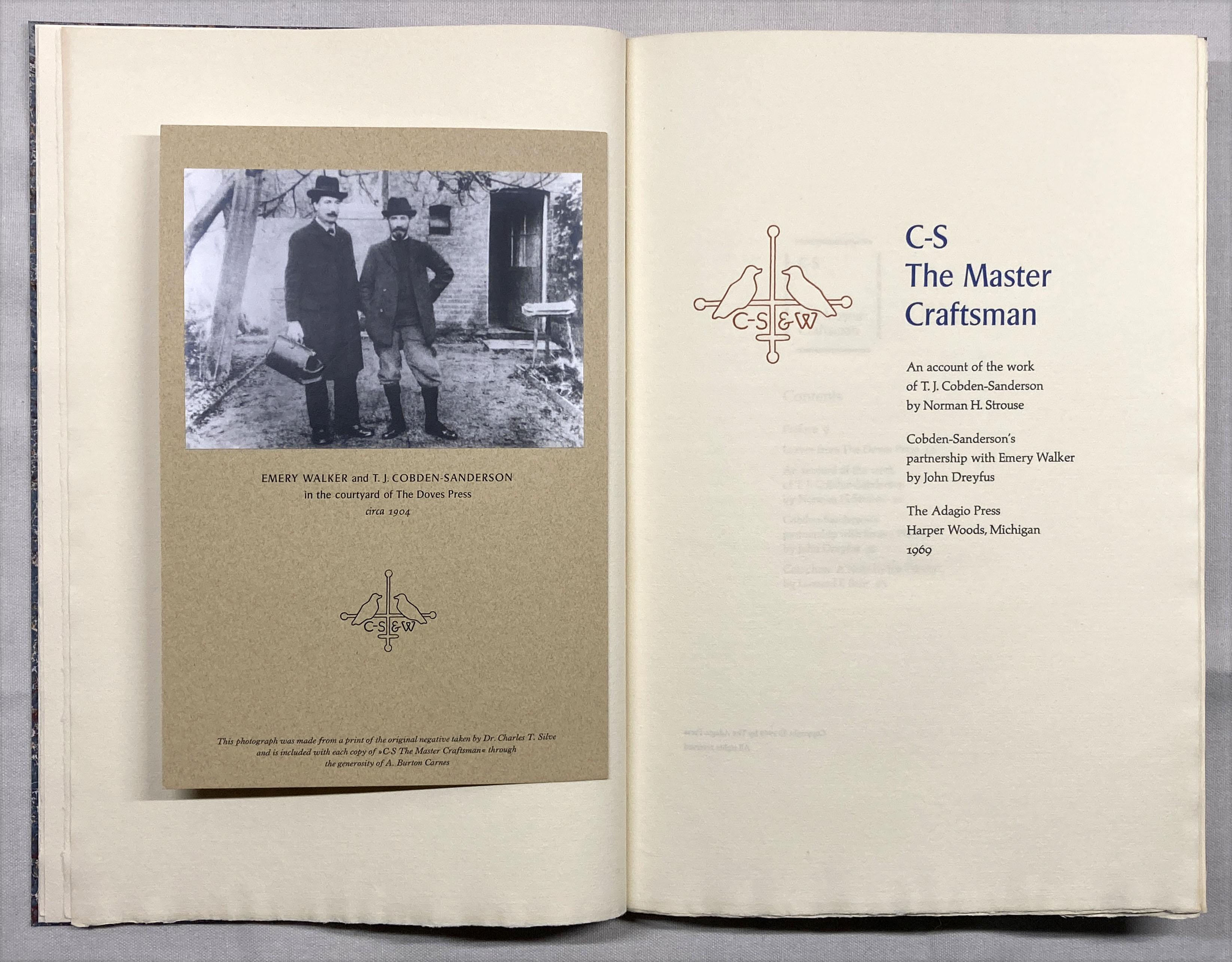

One of the things I didn’t like about the book as issued was the inclusion of a sheet with a photo of C-S and Walker tipped on. (C-S always looks like an insufferable ponce.) This sheet was simply laid into the book. I suspect it might have been an afterthought. I really don’t like books with items laid in (unless there
s a box, and even then...), so I mounted the sheet in my copy opposite the title page. 
 

There were 10 copies  “retree” copies bound up at some time by Campbell-Logan. My copy includes the little slip inserted identifying these as such, so I guess my copy was part of that exercise (i.e. an extra set beyond the 10). I annotated it so as not to defame Campbell-Logan.

AND ANOTHER THING!


Before I got to the binding, I printed the seven sheets that make up the text for Byzantium’s upcoming book about marbling on different papers. For the title page Barbara marbled the sheet, leaving a blank area for the text. She used acrylics so I was able to dampen the sheets for printing (as I did with all the others) without everything running. Each copy will include original marbled samples on at least 51 different papers, grouped by type (handmade, mouldmade, machine-made) and source (Western or Eastern). I believe the edition of 17 copies, uniformly bound by Claudia, will be ready for issue in the fall. 

This month I start printing the next HM book, which also should be ready for publication in the fall. 

Last months Agrippa symposium in London has sparked some requests for copies of HMs About Agrippa. The edition was exhausted some years ago, but Im considering a second printing. If interested send an email please (address at right somewhere).

Next month Ive lined up another guest, Will Rueter, who will share some details and images about what will be The Aliquando Press final book, and an updated bibliography. 


1.5.23

Agrippa (A Book of the Dead) Lives!


A two-day symposium (actual & virtual) about the infamous disappearing Agrippa: A Book of the Dead will be held this month in London. The event addresses some of the many conceptual questions the project sparked, or at least brought into sharp relief: what is a book? What is a book in the digital age? 

The text of Agrippa, published in 1992, was a long free-verse poem by cyberpunk author William Gibson. It was to have been issued in two versions, both limited in number, presenting the same concept: a physical book whose printed text was essentially gibberish, with accompanying etchings by David Ashbaugh. Gibson’s poem was included on a 3.5 computer disc that would auto-encrypt itself after being read once. Similarly, the prints were supposed to have been photo-sensitive, so just opening the book would initiate a change the art. So, Agrippa would present a “reader” with a conundrum: opening the book would change its printed pages irrevocably. Booting the disc to see if Gibson’s text could be read would result in permanently encrypting the text (if it hadn’t already been).  


The symposium is being organized by a PhD candidate, Justine Provino, and most of the participants are scholars who have thought & written deeply about the broad questions Agrippa posed. I’ve been included  because (I think) I’m one of few people interested strictly in the physical aspects of its production, i.e. the most traditional and perhaps mundane aspects. But these mundane aspects posed a number of technical problems to the publisher, and I’m fascinated by the stories about the making of a book, particularly when things go wrong. (See here for a long post about Agrippa and an account of its production I wrote in 2015). 


How much of what was promised in Agrippa’s prospectus ended up happening was long a matter of debate, and answering some of these questions was the focus of my monograph. They couldn’t get the photo-sensitive concept to work, but someone came up with a clever alternative that achieved much the same result. I’ve never been clear on whether the self-encrypting program worked; the copies of Agrippa I’ve seen were issued without a disc. The whole endeavor became somewhat shambolic in the end, but its ambition and provocation inspired many broader discussions (and graduate degrees). 


Agrippa
wouldn’t be classified as fine press by the people who made it or people for whom that phrase means something specific: the production was not the finest. It’s more firmly in the artist’s book realm. Copies rarely come to market. When I wrote my monograph, I found two listed in recent years. One sold on Abebooks for about $5,000, from a bookseller who had it on commission and didn’t really know what it was. The other sold in a modern art auction, for a paltry $800, once again showing that books aren’t really considered art by the market.

If you’re interested in discussions around artists books, what constitutes a book, what is the role of physical books in the 21st century etc etc, this free symposium might be worth dialing in. 
 
AND ANOTHER THING!
 

I
ll print Barbara Hodgson’s Marbling Paper: Experiments to Show That Paper Really Does Matter this month. That’s the title page above: she’ll marble the sheet, then I'll print the text in the white areas. We’ll see how that goes...


1.6.21

Handpress Library #9: Vellum


When someone starts getting interested in letterpress and fine printing, they pretty soon become enamoured with the idea of printing on vellum. Much of the attraction is down to the mystique of vellum* – its cost and related scarcity, and its tactile qualities. Depending how much knowledge acolytes have acquired, they may also appreciate the difficulty of printing on vellum, and the sheer terror fear of wasting a skin with a bad impression. 

I have no idea where one could acquire vellum appropriate for printing these days, and don’t want to know how much a sufficient quantity for even one copy of a book would cost. I guess I’d ask a calligrapher. Vellum suitable for binding is expensive enough, and the kind suitable for printing is much finer. 

 
Printing a few copies of a book on vellum has been part of printing since the first Gutenberg Bible, presumably a sop to patrons with libraries full of manuscripts. In the early days of the fine press revival, copies on vellum were the cream of the cream. In 1977 the Bridwell Library boasted of having secured copies of the so-called fine press Triple Crown – the Ashendene Dante, the Doves Bibles, and the Kelmscott Chaucer – all printed on vellum. The practice dwindled as the century progressed; in this list of known publications on vellum printed in the United States, you can see the gap between the 1950s and '80s. Of the three American presses listed in that revival, if it can be called that, the Petrarch was the most ambitious. That imprint was started by Peter Bishop in 1985 and published eight titles over the next decade, all printed with a handpress. The imprint was revived after Bishop’s death in 2002, and has continued to print a few copies of each title on vellum (i.e. parchment; I won’t address that distinction here...). 

 
All of which brings us to the latest instalment in the Handpress Library: Petrarch Press’ 1989 edition of Epictetus’ Enchiridion, printed on vellum (i.e. sheep skin parchment). The printing is enviously consistent and wonderfully black without being over-inked. The leaves may be slightly more transparent than ideal, but not to the point of distraction. The edition was 160 copies, eight on parchment, mine elegantly bound in brown goat with just the title tooled on the spine.

 
I don’t think this was the first book on vellum I owned: that would have been the De La More Press’ edition of The Prince. I bought it from a catalogue (i.e. sight unseen) in the late ’90s, for about $1,000, which would have been a lot of money for me, but I was in the new-to-printing, beguiled-by-vellum stage. It wasn’t really that lovely. If I recall correctly, the type looked over-inked (De La More was one of those quasi fine presses, like Nonesuch, which claimed to combine fine-printing ideals with commercial methods; I'm sure The Prince’s edition of 1,040 copies was not printed on a handpress, which accounts for the indifferent result). The vellum-over-boards binding was inelegant, and the black lettering on the spine just looked cheap. Plus, my copy arrived with a busted spine, which robbed much of the joy. I used it to acquire something more interesting within a few years. But I didn’t get eight grand in trade!


One question I’ve never answered unequivocally is whether printers dampened vellum before printing, as they would (should) paper. Anyone familiar with vellum knows how it reacts to the slightest change in humidity, so I’m not sure how one would dampen a skin, or if it even helps the impression (as it greatly does with paper). Rummonds, our best contemporary resource for letterpress questions, offers just a page and a half on the subject, and gives most of that to the Kelmscott pressroom overseer: place a skin between (not very) damp blotters for 30 – 45 seconds immediately before printing. The chapter’s unspoken sentiment seems to be, you’re on your own, good luck. 


Robert Baris’ Wind & Harlot Press issued a pamphlet on the subject in 1976 (25 copies, re-printed as a miniature in 1992, 23 copies), printing an exchange of letters between D.B. Updike and St. John Hornby in which the latter reported he printed his vellum dry. 

In the end, the appeal of printing on vellum comes down to decadence, which on its own isn’t that interesting, and is why my interest in books printed on vellum has been attenuated. For the premium placed on a vellum copy, I’d as soon have one printed on good paper and the extra money in my pocket. The closest I’ve come to printing on vellum is Reg Lissel’s vellum paper, made from over-beaten abaca. It’s remarkably similar to vellum in feel and toughness. I used the quick damping between blotters technique, and significantly more impression than would have been required for a rag sheet of comparable weight. If I was presented with a stack of vellum sheets, I don’t know that printing on them would be my first inclination. I’d be more likely to have a calligrapher do something lovely, and tip a sheet into copies of a book. 

* The Mystique of Vellum is the title of Richard Bigus’ bible on the subject, published by Bromer Booksellers in 1984. Copies can still be had, at not much beyond publication price, and each one includes a sheet printed on vellum (shown at top of this post). The April 1987 issue of Fine Print has a fascinating article about binding the 12 copies of Mystique that were printed on vellum, which discusses the challenges of working with vellum quires, and underscores the importance for printers to consult with their binder before production starts. 
 
AND ANOTHER THING!


I forgot to include one of Will Rueter’s publications in last month’s post about printing Bewick’s wood engravings: A Brief Description of His Method of Engraving on Wood, Taken from His Memoir, c.1827. Edition of 100 copies published in 1978, a single signature sewn in wraps. Not sure what the two blocks included are from, probably metal cuts, he’d have mentioned if they were original blocks. Beautifully printed on mulberry paper. 
 
GOT AGRIPPA?
 
Justine Provino, a graduate student at Cambridge, is working on a thesis about Agrippa (A Book of the Dead), including a census of known copies. If you have one, or know where one is, send her a note: agrippa[at]english.cam.ac.uk
 

30.3.15

About Agrippa (A Book of the Dead)


Last week's Eastern Corp post set a new one-day record for views. And so, now for something completely different...

All the copies of About Agrippa (A Book of the Dead) - A Bibliographic History of the Infamous Disappearing Book have been stitched up, stuck in the printed wraps, & distributed to the many people who helped with the research. That finished something that started in 1992 when I saw an advertisement for the "book" in an issue of Science Fiction Eye magazine.

In 1992 publisher Kevin Begos Jr, author William Gibson and artist Dennis Ashbaugh collaborated on a project that anticipated the advent and impact of digital books. The project, titled Agrippa (A Book of the Dead), has enjoyed perhaps one of the most lively and well-documented online afterlives of any late 20th-century book, particularly for one which so few people have ever actually seen, and which so many people believe does not actually exist.


While the collaboration’s initial concept – a digital text that irreversibly encrypts itself during the first reading, making it subsequently inaccessible, paired with light-reactive etchings that degraded over time – and influence have been thoroughly examined by academics, bibliophiles and Internet trolls, the story of its actual production has never been told in one place. (The term “book” is used here to describe the collective parts, including the 3.5-inch computer diskette secreted in a hallow at the back of the book’s text block). Many of the details about its production have come out only over the past decade, as several major institutions acquired archive materials from the project, and devoted attention and resources to chronicle the book’s creation.

The University of California Santa Barbara hosts an excellent and extensive site called The Agrippa Files, but it was written by academics, and their focus and interests are not the same as a publisher/printing geek, so some details about Agrippa’s tangible aspects remained opaque, if not absent altogether. This is what sustained my curiosity since seeing that ad in SF Eye: there's nothing I find more fascinating than a book about whose existence there is some dispute.

The unexpected appearance of an almost complete copy of Agrippa at my home in 2013 was all the push needed to start trying to piece together the story of its publication. While some fundamental questions remain around exactly how things unfolded as they did, About Agrippa... succeeds in irrefutably confirming that publication happened, though not exactly as promised at the time or described by the collaborators since. 

https://www.youtube.com/watch?v=drPpUlTypt4

Transcripts of Gibson’s poem appeared online soon after the book’s launch in December, 1992 (thanks to a surreptitious video recording of the disc being run for the publication launch), but people questioned whether the book object had actually been produced (because so few people ever saw a copy) and whether the self-encrypting disc had been created. Doubts about Agrippa’s existence grew in the years since its publication, in no small part due to misinformation (whether intentional or not) from the three collaborators. Gibson has been quoted in several instances saying the project “never happened” and that he’s never seen a copy (but we know he has seen, at the very least, the copy held at the New York Public Library). In the section of Ashbaugh’s Web site about Agrippa, he includes aspects of the production that we know were initially planned but ultimately not achieved (most notably the light-reactive etchings). Begos’ descriptions of the editions published are vague, particularly with regard to the $7,500 “deluxe” issue of 10 copies; he also mentioned “artist’s proof” copies at one point (and he states that both Gibson & Ashbaugh received their A.P. copies in 1992). Questions sent to each of the three collaborators for the article went unanswered. The printers of the etchings and the letterpress, however, provided some new and valuable details about the project via email and postal correspondence.


Perhaps the biggest mystery in the tale of Agrippa’s production is exactly what happened to the Small Edition, which was to have been issued in an edition of 350 copies. We know it was abandoned, perhaps even before the December, 1992 launch event in New York City. At that event Begos reported that copies of the Small Edition were for sale at the Met’s mezzanine gallery. (He also stated the Deluxe Edition was almost sold out, although we know that text and prints for fewer than half the planned 95 copies had been printed.) Five copies of the Small Edition can be traced, but they are not identical: one was issued with the printed sheets torn into leaves, the etchings reduced and reproduced with a photocopier, clippings from a 1938 newspaper randomly inserted throughout, and the whole thing stuffed into the case binding, like a folder (shown below). By April, 1993, the Small Edition is no longer mentioned.


About Agrippa… attempts to trace the production of Agrippa’s physical parts - the text pages, the intaglio prints, the binding, the box. Publisher Begos succeeded in attracting extensive mainstream media coverage for the project prior to publication, and these articles provide insights to how aspects of the initial concept changed or disappeared during 1992. The prospectuses and notices he issued notably lack bibliographic details like edition size and descriptions of the different states being issued. With access to copies of both the Deluxe and Small editions, interviews with a key participants in the production work, and cross-referencing a wide variety of interviews, catalogue descriptions, and print articles, a more clear picture of what exactly was - and was not - issued appears: Agrippa was published (though not exactly as planned), copies do exist (though there does seem to be much variety in their exact details and completeness), and we can trace for certain two copies sold on the market since 2010 (for wildly different prices).


"Begos has spoken extensively about why the book was what it was. Ultimately Agrippa, like many artist’s books, was an interesting thought experiment but the thing itself was practically inconsequential. The discussion it generated is almost entirely centered on the concepts it challenged – ownership versus experience, digital vs physical – and not at all on the design or the (written) content. The message was entirely in the (lack of) medium. The box was hard to store (it couldn’t be put on a shelf with your other books, upright); the book was simply a portfolio for the prints and disc – there was nothing to read; and for most book collectors the paradox posed by the project – to own it or experience it – proved easier to resolve by ignoring than engaging."

About Agrippa... consists of a main article (approx. 10,000 words) recounting the initial plans for Agrippa’s physical parts, and detailed descriptions of (and differences between) copies issued. Interviews with several key participants add context to the technical challenges faced, and how these were resolved (or not). The essay is accompanied by marginal notes with commentaries, expansions, digressions & sometimes subjective editorializing (like the excerpt above) on details, contradictions and inconsistencies in the main text. Numerous original photographs of Deluxe and Small edition copies are included. Appended are a select bibliography of other publications from Begos, a facsimile resetting of a prospectus of which only one copy is known to exist, and a detailed list of references. Here's the Table of Contents:

      Source Files 
      The Artifact      
      The Concept
 
    The Paradox
 
    The Publisher
 
    Confusion
 
    The Edition[s] As Planned
 
    Typography & Letterpress
 
    The Deluxe Edition [As Issued]
 
    What About the “Super-Deluxe” Copies?
 
    The Prints
 
    The Small Edition [As Issued]
 
    How Many Copies Are There, Really?
 
    Follow The Money
 
    Afterlife


About Agrippa... is 8.25-by-11.5 inches, 40 pages, printed in full color, sewn in sections and put into a stiff paper cover. Fifty copies were produced, with most being distributed to people and institutions who assisted in the research. Fewer than 20 copies remain, available at $50 plus shipping.